
Portable power stations, solar generators, and battery backup.
Separate stored energy from output power, estimate essential-load runtime, and check charging and transfer behavior before buying.
On this page (9)
Choose the backup job before the battery size.
A portable power station stores energy in a battery and supplies compatible devices through its outputs. A “solar generator” is commonly a power station paired with solar charging equipment; it still depends on stored energy and available sunlight. A UPS, a portable station, and an installed home battery can have different transfer behavior and installation requirements.
List the devices you need, their running power, any starting surge, and the hours required. Separate essential small electronics from refrigeration, pumps, heating, or other high-demand equipment. A large watt-hour number alone does not show that a battery can start a motor or support a sensitive device during an outage.
Choose backup around the load and outage.
Transfer interruption, output quality, reserve, and approved pass-through use.
Compare a suitable UPS with power-station behavior.
Running and surge watts, watt-hours, and recharge options.
Build a load sheet and runtime estimate.
Installed transfer arrangement, load capacity, storage, and recharge.
Plan a complete system with a qualified installer.
Read watts and watt-hours as different specifications.
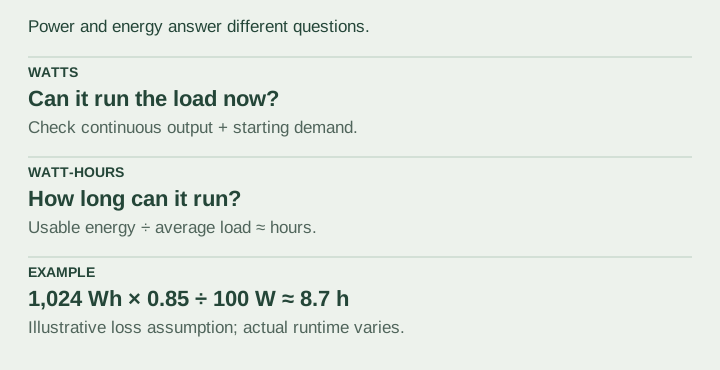
Watts describe power at a moment; watt-hours describe energy. The continuous AC output must support the simultaneous running load. A surge rating applies for a limited condition and duration. Marketing boost modes may change output behavior and should not be treated as the normal continuous rating for every appliance.
As an illustrative example, a 1,024 Wh battery supplying an average 100 W load has a theoretical 10.24-hour result before losses. If you assume 85% usable delivered energy for planning, the result is about 8.7 hours. That 85% is an example assumption, not a measured efficiency for a specific product. Standby draw, temperature, battery condition, and load behavior change the outcome.
Build a load sheet that captures cycling and startup.
For each device, record its name, voltage, running watts, startup requirement, expected duty cycle, and planned operating hours. Use manufacturer information or a suitable measurement method for ordinary plug-in equipment. A refrigerator does not necessarily run its compressor continuously, while a sump pump may cycle rapidly during heavy inflow.
Add simultaneous loads, then check each outlet’s limit as well as the total output limit. A device’s plug fitting into an adapter is not proof of electrical compatibility. For medical or other critical equipment, obtain the equipment provider’s backup requirements and validate the complete setup; a general portable-battery estimate is insufficient.
Check solar input as an electrical compatibility problem.
Compare the station’s permitted input voltage, current, power, connector, and polarity with the panel arrangement. Panel open-circuit voltage and temperature behavior matter. Do not connect a series or parallel arrangement solely because its combined advertised wattage looks suitable. Follow the exact station and panel instructions.
Manufacturer limits differ substantially: EcoFlow’s DELTA 2 Max and DELTA Pro manuals specify different solar input voltage ranges. The lesson is to verify the chosen model, not to reuse a wiring arrangement from a different battery. Solar recharge time also depends on conditions, orientation, shading, and charging limits; rated panel watts are not a guaranteed all-day output.
Verify outage behavior and household connection.
If the station will sit between the wall and an appliance, check whether that use is approved, the transfer interruption, pass-through limits, and battery reserve settings. An emergency-power feature is not automatically a zero-interruption UPS. Test noncritical equipment under the manufacturer-approved procedure before depending on it during an outage.
Power household circuits only through an approved installation designed by a qualified electrician. Never backfeed a wall outlet. Keep portable equipment within its environmental and ventilation limits, and inspect for damage. Use the manufacturer’s charging and storage instructions, including temperature restrictions and any maintenance charging schedule.
Compare the complete package and upkeep.
Price the station, any expansion batteries, solar panels, approved cables, cart or storage arrangement, and optional installed transfer equipment. Check warranty terms, battery service options, app dependence, and whether replacement accessories remain available. A heavier station with more energy may be impractical if it must be carried upstairs during every outage.
Keep a written outage plan with the essential-load order and recharge options. Periodically verify battery readiness and the required devices. If the runtime target is not met, reduce load, increase supported storage, or choose a different backup architecture rather than relying on an optimistic product headline.
Common questions
Does a solar generator generate power at night?
Its battery can supply stored energy, but solar charging requires suitable light.
Can a 1,000 Wh station run a 1,000 W load for an hour?
One hour is the ideal arithmetic result before losses and limits. Actual delivered runtime will be lower or otherwise constrained by the model and conditions.
Is surge wattage the same as continuous output?
No. Check the allowed duration and load conditions in the specification.
Can I plug it into a home wall outlet to power the house?
No. Household circuit backup requires an approved transfer arrangement; do not backfeed an outlet.
Sources and product instructions
Use the exact equipment manual and local requirements for installation or service. These references support the checks above; product examples do not establish compatibility with your equipment.