
Sprinkler systems: plan the zones and locate a repair.
Map the water supply, controller, valves, and outlets before designing an irrigation system or troubleshooting an existing one.
On this page (9)
Start with a zone map, not a longer watering schedule.
An irrigation system combines a water supply, backflow protection, distribution piping, zone valves, a controller, and outlets. A zone is a group of outlets operated together. Poor coverage can come from a broken part, a supply limitation, or a layout that never matched the planting area. More runtime does not distinguish these causes.
Draw the lawn and beds, mark sun and shade, and number the zones. Under normal controller operation, record which outlets run, where spray lands, and where water collects. Keep people clear of damaged wiring or exposed equipment; shut the system off for an uncontrolled leak.
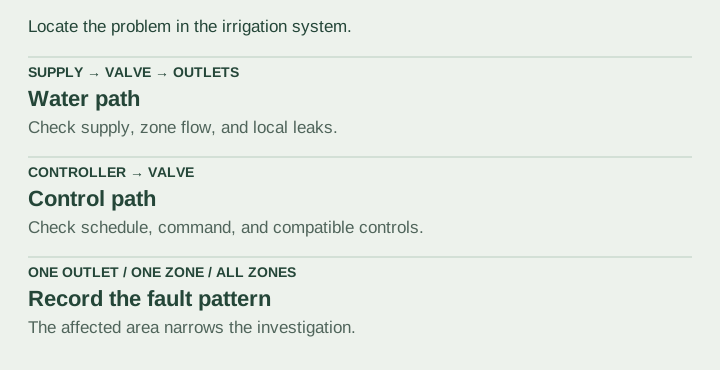
Use the affected area to narrow the fault.
Head damage, nozzle blockage, and local connection.
Use the sprinkler-head guide.
Supply, valve operation, wiring, and zone demand.
Record the pattern before ordering parts.
Program start times and overlapping schedules.
Check controller programming before hardware replacement.
Match each zone to one watering task.
Group plants with similar water needs and separate areas with substantially different exposure, soil, or slope. A vegetable bed on drip and a turf area on sprinklers usually need different operating times. Mixing them under one schedule makes it difficult to give both the intended amount of water.
Before a new installation, have available pressure and flow evaluated under operating conditions. Static pressure alone does not establish how many heads can run together. Ask the designer for the expected zone flow, required outlet pressure, pressure losses, and the reason for each zone boundary. Include local watering rules and backflow requirements in the proposal.
Use the fault pattern to narrow the repair.
One damaged outlet with otherwise normal coverage points toward a local head or connection issue. An entire weak zone calls for inspection of supply, valve opening, leaks, and total demand. Every zone failing suggests a shared supply, controller, sensor, or wiring problem. These are starting branches, not proof of a failed component.
Record whether the problem occurs on manual activation, the scheduled program, or both. If a system runs through its stations repeatedly, inspect program start times: on many controllers, each start time launches the whole program. Do not order valves because the same stations appear more than once.
Measure application before changing runtime.
For turf sprinklers, use identical catch containers across the area during a timed test when conditions are suitable. Compare the amounts to identify uneven delivery. If a hypothetical uniform test collects 0.2 inch in 15 minutes, the calculated application rate is 0.8 inch per hour. Delivering 0.4 inch would take about 30 minutes at that measured rate, before accounting for runoff and other limits.
This example is arithmetic, not a watering recommendation. Determine the actual irrigation requirement from rainfall, plant needs, soil moisture, season, and restrictions. If runoff begins early, the system may need cycle-and-soak scheduling or a design repair rather than one uninterrupted run. Correct broken or misdirected heads before using test results.
Compare installation and repair proposals by deliverable.
A useful system proposal includes a zone drawing, water-supply assumptions, valve and controller models, outlet types, backflow work, excavation and restoration, programming, and startup testing. Ask whether permits, utility locating, and seasonal shutdown are included where relevant. Establish who repairs disturbed turf or paving.
For a repair, request the diagnosed failure, affected zone, replacement specifications, and a before-and-after operating check. A low parts price does not describe the excavation, inaccessible piping, or cleanup. Keep the final zone map and settings so the next fault does not require rediscovering the system.
Verify the result while the system runs.
Watch each zone finish an ordinary test cycle. Check coverage at edges, overspray onto pavement, leaks around fittings, and whether water stops after the zone closes. A small amount of low-point drainage immediately after shutdown differs from a continuing flow that never stops. Note the duration before reporting a leaking valve.
Review the controller calendar, start times, station durations, seasonal adjustment, rain or soil sensor behavior, and any app schedule. Make one change at a time and record it. A smart controller can adjust a sound system; it cannot repair a split pipe or make incompatible outlets deliver water evenly.
Common questions
Can sprinklers and drip share a zone?
They may require different pressure, filtration, and runtime. A design should explicitly account for those differences; separate zones are often more manageable.
Why does the system run twice?
Multiple program start times can repeat every station in that program. Check the exact controller instructions.
Can a smart controller fix brown patches?
It cannot correct blocked outlets, leaks, poor placement, or uneven application.
Does strong pressure at a faucet prove the design will work?
No. Available flow and pressure under the expected simultaneous demand must also be evaluated.
Sources and product instructions
Use the exact equipment manual and local requirements for installation or service. These references support the checks above; product examples do not establish compatibility with your equipment.