
Well pressure tanks: drawdown, cycling, and replacement fit.
Separate tank storage volume from usable drawdown and investigate frequent pump cycling before ordering a replacement pressure tank.
On this page (9)
The tank supports pressure control; it does not create well yield.
A well pressure tank stores a usable amount of water under pressure and works with the pump and controls to reduce unnecessary starts. It cannot make a low-yield well produce more water or remove contaminants. Low pressure, poor flow, and frequent cycling can have different causes.
Record the tank model, pump and control arrangement, pressure-gauge behavior during normal use, and recent changes. Note whether the problem affects every fixture, only peak demand, or one branch. Do not adjust pressure switches or add air based only on a symptom description.
Separate drawdown, cycling, and water supply.
Drawdown at actual pressure settings and pump run-time requirements.
Use the manufacturer’s sizing data.
Demand pattern, pressure range, leaks, charge, and controls.
Diagnose before replacing the tank.
Well yield, pump, restrictions, and distribution.
Do not assume a larger tank will solve supply problems.
Compare drawdown rather than nominal tank gallons.
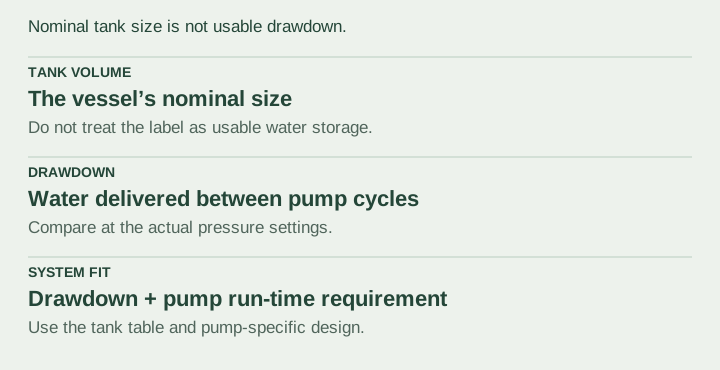
Nominal tank volume is not the same as the water delivered between pump start and stop. Drawdown depends on the tank design and pressure settings. Compare the manufacturer’s drawdown table at the actual operating conditions and the pump’s required minimum run time.
As an illustrative sizing calculation, a system delivering 10 gallons per minute with a one-minute required run interval would need a 10-gallon drawdown basis before other design considerations. The run-time requirement must come from the pump and system design; this is not a universal one-minute rule. A tank labeled with a much larger nominal volume may provide only part of that volume as usable drawdown.
Investigate short cycling as a system symptom.
Rapid starts and stops can involve lost air charge, a damaged bladder or diaphragm, control settings, a leak, check-valve issues, or an unsuitable tank. The pattern matters: cycling during steady use differs from cycling when no water is being used. Record the time between starts and the observed gauge range from a safe position.
Have a qualified well professional test the system and identify the cause. Replacing the tank without addressing a leaking line or control fault may leave the symptom unchanged. If the pump runs continuously or water stops, the investigation also needs the water source, pump, and restrictions rather than a tank-only assumption.
Treat precharge as a model-specific service setting.
Amtrol’s referenced WELL-X-TROL residential instructions describe precharge relative to pump cut-in pressure and require the appropriate depressurized, drained condition for checking. The often-cited “2 psi below cut-in” instruction belongs to applicable tank and control arrangements; it should not be transferred blindly to every well system.
Do not check or adjust an unfamiliar pressure vessel while it remains pressurized, corroded, damaged, or electrically unsafe. Follow the exact tank and pump instructions and use professional service when the arrangement is uncertain. A pressure switch cover can expose hazardous electrical components even though the task appears to be about water pressure.
Build the replacement and quote specification.
Compare the required drawdown, operating pressure limits, physical dimensions, connection size and orientation, support, access, and approved potable-water application. Include the tank tee, pressure gauge, relief protection, controls, valves, and associated fittings as required for the designed system. Ask which components are retained and why.
A complete quote should separate tank, labor, disposal, piping changes, control or electrical work, testing, and any access or clearance changes. Request the final pressure settings and sizing basis in writing. If space constraints drive a different arrangement, have the installer explain how it preserves the required pump operation.
Verify the repair under normal and no-demand conditions.
At handover, ask the professional to demonstrate stable pressure behavior, appropriate pump cycling, and leak-free connections. Confirm that the system does not cycle unexpectedly when household demand is stopped, allowing for any equipment that uses water automatically. Keep the model, settings, test results, and warranty.
A pressure-system repair does not establish drinking-water quality. Follow the relevant well testing and disinfection guidance after work that could affect the water system, as directed by the qualified provider and local health authority. Continue investigating taste, odor, sediment, or contamination concerns through the appropriate water tests.
Common questions
Is a 40-gallon tank 40 gallons of usable water?
No. Usable drawdown depends on tank design and operating pressure settings.
Will a bigger pressure tank increase well yield?
No. It changes storage and cycling behavior, not the well’s water production.
Should every tank be set 2 psi below cut-in?
Use the exact tank and system instructions. That common setting is not a universal rule for every control arrangement.
Can a new tank fix contaminated well water?
No. Pressure equipment and water treatment address different problems.
Sources and product instructions
Use the exact equipment manual and local requirements for installation or service. These references support the checks above; product examples do not establish compatibility with your equipment.