
Sump pump selection, replacement, and installation cost.
Match the pump to water inflow and discharge head, then compare the basin, piping, electrical work, and testing in the installed price.
On this page (9)
Choose capacity at the actual pumping height.
A sump pump collects and moves drainage water from a basin to an approved discharge location. Its useful capacity depends on the system’s head, not just the largest gallons-per-hour number on the box. The discharge rise, pipe route, fittings, and restrictions affect performance.
Record the existing pump model, basin dimensions, normal water levels, discharge pipe size and route, and how often the pump runs during heavy inflow. Do not enter standing water near electrical equipment. If the basin is rising rapidly or the pump has failed during flooding, prioritize safe professional assistance over experimenting with parts.
Compare pump performance and installation scope.
Basin, switch, discharge route, power, and original fault.
Compare a documented compatible replacement.
Collection, basin, excavation, discharge, and electrical scope.
Price the entire installation.
Flow at the same assessed head and installation constraints.
Use the pump curve, not horsepower alone.
Read the pump curve and installation constraints together.
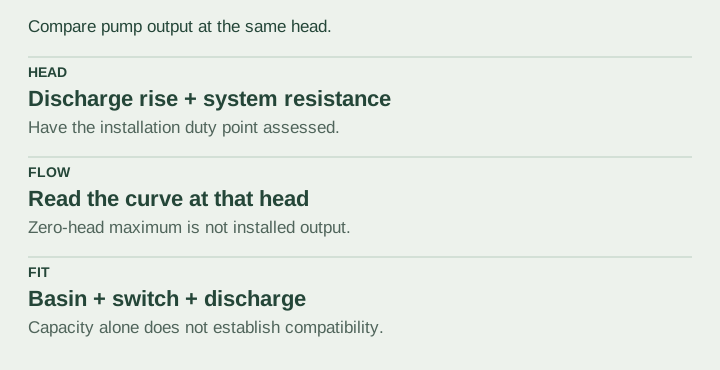
Compare the manufacturer’s flow curve at the assessed total dynamic head. A maximum flow at very low head is not the expected output for an elevated discharge. Horsepower alone does not establish which pump will deliver more water in your installation. Have a qualified installer estimate the required duty point and reserve.
For a hypothetical comparison, Pump A delivering 2,000 gallons per hour at the project’s assessed head provides about 33 gallons per minute. Pump B’s headline of 3,000 gallons per hour at zero head cannot be compared until its flow at the same project head is known. These are invented numbers demonstrating how to compare a curve, not product recommendations.
Match the basin, switch, and discharge arrangement.
Check whether the pump and float can fit and move freely without contacting the basin wall, piping, or another pump. Float travel and start/stop levels affect cycling. The discharge arrangement needs the correct pipe size, check valve, venting or anti-airlock provisions where specified, and an approved destination. Follow the exact pump instructions.
Do not drill a generic hole or change valve location based on another model’s diagram. Some installations have specific vent-hole and valve requirements. A cover must accommodate the installation and local needs while preserving service access. If the basin or drainage collection is inadequate, changing only the pump may not solve the problem.
Separate replacement from a new installation.
Replacing an accessible compatible pump in a sound basin is a different job from cutting a slab, adding drainage, creating a basin, routing a new discharge, and providing electrical work. Ask the installer to name which existing components remain and which will be replaced. Include the reason for any capacity change.
For installation cost, obtain lines for pump, basin and cover, excavation or concrete work, drainage connections, discharge piping, check valve, electrical work, permits where applicable, disposal, restoration, and testing. This page does not assert a national cost range because site work can dominate the price. A hardware-only listing is not an installed estimate.
Normalize quotes with a simple example.
In an original hypothetical comparison, a $650 pump replacement plus $120 for required valve and piping work totals $770. A $740 proposal including the same work would be $30 lower, if equipment, warranty, and testing are equivalent. These figures are invented to illustrate quote arithmetic, not typical charges.
Ask about backup and high-water notification separately. A new primary pump still depends on its power supply and can fail mechanically. For a finished basement or frequent inflow, compare the consequences of failure with a suitable backup arrangement and a monitored alarm. Do not assume an ordinary small UPS can start and run the pump.
Verify operation and retain a maintenance record.
Have the installer demonstrate an approved water test, float movement, pumping, shutdown, discharge, check-valve operation, and any alarm. Confirm that the outlet remains clear and that discharged water does not return toward the foundation. Keep electrical testing and modifications with a qualified person.
Record the model, installation date, curve or duty-point basis, switch arrangement, and maintenance instructions. Inspect and test at the intervals specified and before periods of expected heavy use. Report short cycling, unusual noise, continuous running, or falling capacity promptly; those symptoms can involve the system as well as the pump.
Common questions
Should I buy the highest-horsepower sump pump?
No. Match the required flow at the actual head and the basin and switching arrangement.
Does replacement always include a check valve?
Not automatically. Confirm whether the existing valve is retained or a new compatible valve is included.
Are the sample prices national averages?
No. They are hypothetical arithmetic examples; obtain local itemized quotes.
Can a stronger pump fix every wet basement?
No. Drainage collection, foundation water management, discharge, and other water sources may also require work.
Sources and product instructions
Use the exact equipment manual and local requirements for installation or service. These references support the checks above; product examples do not establish compatibility with your equipment.