
Indoor Air
Choose the right task for your indoor air.
Compare particle filtration, moisture removal, humidifier consumables, and bathroom exhaust. Start with the room and the problem you can measure.
Choose the task in front of you.
Start with what you can observe, then collect the measurements or model details that matter.


Find the next step
Keep connected tasks together.
Use the related guide when a symptom points to a different part of the system.
Air purifier size and filters
Compare performance on a defined room basis.
Read guideDehumidifier size and use
Measure humidity and plan collection or drainage.
Read guideDehumidifier not collecting water
Separate low load, settings, and a fault.
Read guideHumidifier filter replacement
Match a wick, panel, or another consumable.
Read guideBathroom fan size and fit
Compare CFM, noise, ducting, and controls.
Read guideBathroom fan not working
Check silent, noisy, and weak-extraction symptoms.
Read guideBrowse indoor air guides
Indoor Air essentials & common questions
Different problems need different equipment.
An air purifier filters particles or selected gases as air passes through it. A dehumidifier removes moisture. A humidifier adds moisture. A bathroom exhaust fan sends indoor air outdoors. Those functions can complement one another, but one label such as air treatment does not make the devices interchangeable.
If the complaint is dampness, measure relative humidity and investigate water sources. If it is particles, define the room and filtration task. If moisture builds during showers, check the exhaust path and operating pattern. If it is sewer-like odor, a plumbing investigation may be more relevant than another air filter.
Use measurements that match the question.
Room dimensions help compare an air cleaner’s documented CADR or coverage basis. Relative humidity and room temperature help assess a dehumidifier’s load and operating conditions. A fan’s installed exhaust performance depends on the duct, not just the motor label.
A consumer air-quality monitor reports only the pollutants and parameters it actually measures. A generic air-quality score is not proof that every contaminant is absent, and a humidity display is not a mold detector. Use the instrument’s units, stated limits, placement guidance, and trends.
Match the consumable to the exact appliance.
A furnace filter, purifier cartridge, humidifier wick, and water panel serve different jobs. A shared brand or similar shape does not establish compatibility. Keep complete model numbers, documented replacement references, package quantities, and any reusable support parts.
Cleaning a washable prefilter does not make another filter stage washable. Follow each element’s instructions and service the water-contact parts of humidifiers separately. Record actual replacement and cleaning dates before resetting a maintenance indicator.
Keep the source of the problem in the plan.
Filtration does not repair a leak, ventilation does not renew a damaged base seal, and dehumidification does not remove existing water damage. Look for the building or activity that creates the problem, then choose equipment for the remaining task.
Avoid intentional ozone generation in occupied rooms. Use qualified help for concealed duct faults, persistent building moisture, electrical work, and concerns that extend beyond ordinary appliance maintenance.
Dimensions, usual door state, temperature, and how the room is used.
Particles, moisture, odor, poor exhaust, or a specific consumable match.
Measured units and trends, appliance model, and recent changes.
Correct the source, compare a documented product capability, or arrange diagnosis.
Compare the complete ownership task.
Before buying, confirm where the device will stand, the clearance and electrical requirements, the noise you can accept, and how you will clean, drain, or replace its consumables. A large capacity or coverage number does not describe that daily work.
Keep a record of the model, compatible replacement parts, service dates, and the measurements used to choose it. When the room or use changes, revisit the original assumptions instead of automatically ordering a larger unit.
Common questions
Do I need a purifier or a dehumidifier?
Use a purifier for an appropriate filtration task and a dehumidifier for measured excess moisture. Neither substitutes for source repair or suitable ventilation.
Can one device treat the whole house?
A portable product is usually intended for a defined area with adequate circulation. Whole-house treatment needs a different design assessment.
Does a replacement-filter reminder measure filter condition?
Not necessarily. Many reminders are time-based. Follow the actual inspection and replacement instructions for the exact element.
Sources and product instructions
Use the instructions for the exact equipment and the requirements for your location. These guides help organize observations and choices; installation and professional diagnostic procedures remain product-specific.
Image credits
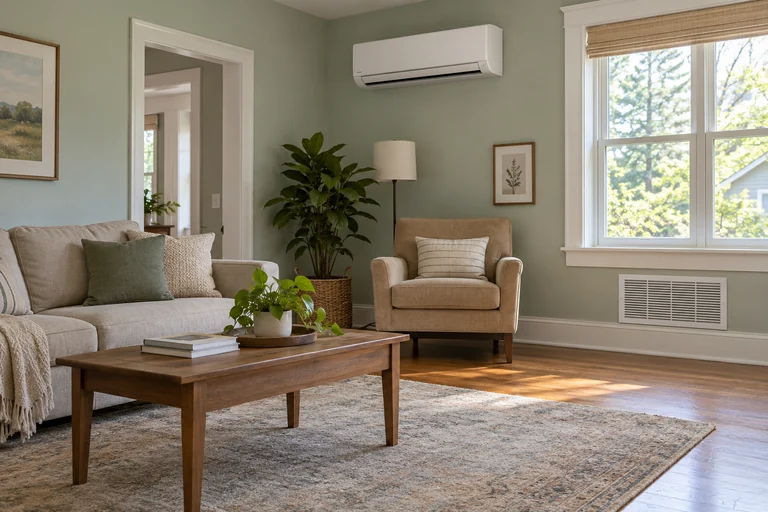
Room and household task scenes are existing AI-generated Field52 illustrations. The outdoor heat-pump photograph, where shown, is by alpha innotec via Pexels. Images illustrate a household setting and do not establish product compatibility or an installation method.