
Baseboard describes the room heater—not necessarily its fuel.
Not always. Electric baseboards make heat in the room; hot-water baseboards receive heat through piping. Identify the heat source—not just the cabinet. U.S. Department of Energy.
Three arrangements that can look similar
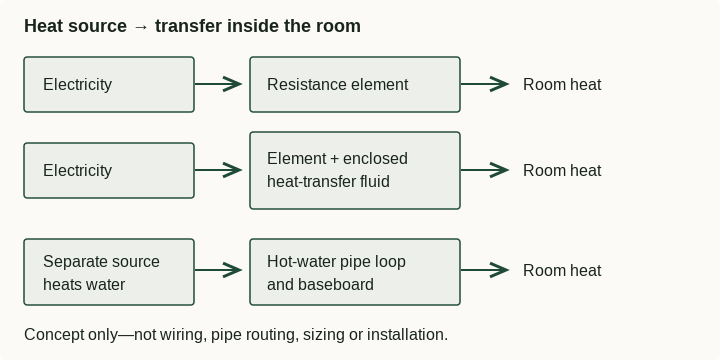
| Arrangement | Where heat comes from | What the label does not prove |
|---|---|---|
| Standard electric | An electrical resistance element in the baseboard. | Appearance does not establish replacement compatibility. |
| Self-contained liquid-filled electric | An electric element heats fluid inside the heater. | “Hydronic” does not necessarily mean a separate boiler or a gas supply. |
| Externally supplied hot water | Water from a separate heat source. | Water does not establish the boiler’s fuel. |
What is an electric baseboard heater?
A conventional electric baseboard heats a resistance element. Metal fins transfer that heat to the room air. Cadet.
In a typical convection arrangement, cooler air enters below and warmed air leaves above. Use the exact model’s instructions to keep its air path unobstructed. U.S. Department of Energy.
Hydronic does not automatically mean gas
Cadet’s SoftHeat is liquid-filled electric: an element heats mineral oil inside the unit. It demonstrates why “hydronic” does not establish gas fuel—not model or wiring compatibility. Cadet.
A hot-water boiler may use gas, oil, propane or electricity. Identify its fuel separately. U.S. Department of Energy.
Identify yours without opening the heater
Start with information you can obtain without dismantling equipment:
- Record the exact brand and model from paperwork or an externally readable label. Do not remove an electrical cover or reach into a hot heater just to identify it.
- Find the matching manufacturer document. Look for an explicit description of electric resistance, a self-contained fluid element, or a hot-water connection—not just the word baseboard.
- For a documented water-loop system, identify its heat source separately. Use the boiler record or ask the building owner or heating professional.
- If you still cannot tell, ask for help. If the label is missing or access is unsafe, ask the manufacturer or a heating professional to identify the type before choosing controls or replacement parts.
Do not open covers, test live voltage, trace hidden pipework or change wiring to identify the heater. Use existing documents and a photograph of the outside instead of guessing from its length or paint color.
Common questions
Does a liquid-filled baseboard need plumbing?
Not always. Cadet’s SoftHeat is a self-contained electric heater that needs no plumbing. That does not apply to a different model or to a boiler-fed hot-water loop. Cadet.
Does a wall thermostat prove which type I have?
No identification should rest on that clue alone. Match the heater and its control documentation. This guide does not determine thermostat compatibility or authorize a replacement.
Should I replace baseboards with a heat pump?
That is a separate project decision. Once the current arrangement is known, compare the rooms, distribution and installation scope in the existing ductless guide and ducted guide. Identifying a heater is not a recommendation to replace it.
Sources and limits
Show SourcesHide Sources
Sources checked: October 26, 2026.
- Cadet, a heater manufacturer: how its electric and liquid-filled baseboards work.
- U.S. Department of Energy, a federal agency: electric heating and boiler-fed hot-water systems.