
Start with a regional shortlist
Use a local Extension or municipal rain-garden list as a starting point. NC State cautions against blanket recommendations: observe drainage and how long water remains after rain before choosing.
Ask two separate questions: “Is this native to my region?” and “Will it suit this site?” A US-native label is not a local-range check. Regional rain-garden lists may also include nonnative ornamentals; read each entry rather than assuming the whole list is native.
Use the USDA hardiness map to check winter-temperature suitability. It does not replace checks for summer heat, sunlight, soil moisture or your garden’s microclimate.
Match the position, not just the plant label
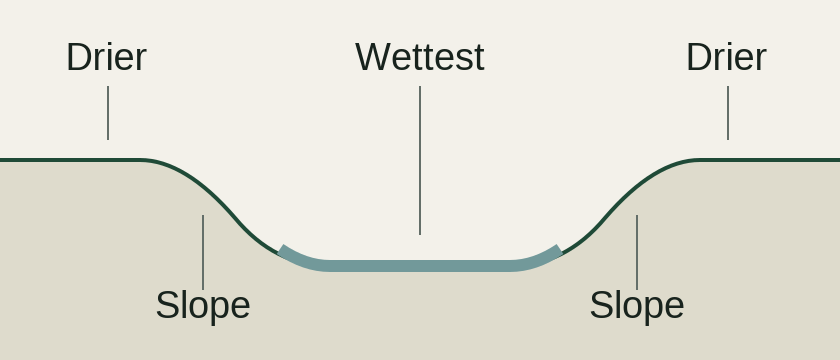
The bottom is usually wettest; slopes transition toward a drier perimeter or berm. Plants must suit the actual wet-and-dry cycle, not simply be described as “water-loving.” Record sun and shade separately for each position.
If drainage or garden siting is unresolved, settle that first. Choosing different plants is not a substitute for checking the installation. See the companion rain-garden planning guide.
Regional choices—not a national ranking
Use these examples to see what a local list can tell you. These are conditional examples, not guaranteed matches for your yard.
| Regional example | Fit and adult growth |
|---|---|
| Minnesota Asclepias incarnata Swamp milkweed | Full sun; wet soil with occasional standing water, or moist but not wet soil. Height: 36–48 inches. |
| Minnesota Asclepias tuberosa Butterfly weed | Sun/partial sun; dry, well-drained soil. Height: 12–24 inches. A drier-position contrast. |
| Minnesota Arisaema triphyllum Jack-in-the-pulpit | Partial sun/shade; wet soil with occasional standing water, or moist but not wet soil. Height: 8–24 inches. |
| Jefferson County, Washington Carex obnupta Slough sedge | Bottom zone. Height/width: 15–30 inches; spreads aggressively by rhizomes (underground stems). |
| Jefferson County, Washington Fragaria chiloensis Coastal strawberry | Sides/upper perimeter. Height: 4–8 inches; width: 24–36 inches. Spreads; may need edge trimming. |
Confirm mature spread where it is not supplied here, and check light requirements for the Washington examples in local guidance. Continue with the Minnesota plant table or Jefferson County plant guide (PDF) only in the relevant regional context. Elsewhere, start with your own local guidance.
Check identity, adult size and spreading habit
Compare mature height and width with the space available. Plan perennial coverage and woody-plant spacing around adult growth, not the nursery pot. Check the exact cultivar rather than borrowing dimensions from a different selection.
Before buying, match the scientific name to current state and local invasive-plant restrictions. For example, Washington quarantines yellow flag iris (Iris pseudacorus), restricting its sale and distribution. That is a Washington example, not a claim of a nationwide ban.
Keep a short purchase note: exact plant identity, regional source, intended position, light, adult size and care needs. Nursery availability and local provenance still need confirmation; this page does not check stock.
Leave room in the plan for establishment
A rain garden is not maintenance-free. NC State’s rainscaping guidance calls for watering until plants establish and during extreme drought, along with weeding, pruning, replacing plants and renewing mulch. Agree on who will do that work before planting.
Watch how each planting position behaves through wet and dry weather. Keep notes on struggling plants and discuss them with local Extension before buying replacements. Recheck the site match rather than treating a plant’s failure as proof that every rain-garden species will fail there.
Sources
Read sources
NC State Extension: conditional selection and rainscaping care. USDA: hardiness-map limits. University of Minnesota Extension and Washington State University Extension: regional examples. City of Bothell: moisture positions. Virginia Cooperative Extension: mature size and planting. Washington State Noxious Weed Control Board: yellow flag iris restrictions. Checked October 29, 2026.