
Heating & Cooling · Practical guide
Furnace not turning on or not heating
Separate no-start, fan-only, interrupted ignition and weak-heat symptoms. Check accessible controls safely and know when gas, oil or electric heat needs service.
At a glance
- Check
- For an emergency first
- Identify
- The heating system
- Describe
- What the furnace does
In this guide
Start by describing what the furnace does. A completely silent system, a fan moving unheated air, a burner that starts and stops, and a house that never reaches the setting are different problems. The thermostat saying “Heat On” is a request for heating, not proof that the furnace is delivering it.
Check for an emergency first. With no warning signs, review the thermostat, known external power controls, homeowner-serviceable filter and room grilles. If those checks do not restore normal heating, arrange qualified service. Do not keep resetting the furnace or open fuel and electrical compartments to find the fault.
- Emergencies come before troubleshooting
- Match the symptom to the next useful question
- When to stop and what to tell the service company
Emergencies come before troubleshooting
Identify the heating system before choosing a branch
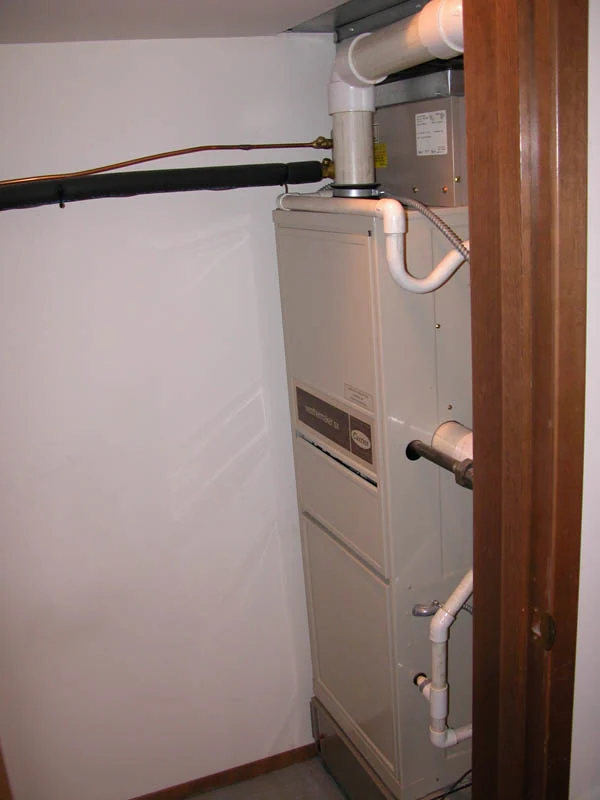
- A natural-gas or propane furnace burns fuel but still needs electricity for its controls, ignition and blower. A power interruption can therefore stop a gas furnace too. Trane explains this in its no-start guide.
- An oil furnace has a burner and an oil supply. Its burner control and reset behavior differ from those of a gas furnace.
- An electric resistance furnace heats electric elements. Gas-valve, pilot-light and oil-pump instructions do not apply.
- A heat pump or combined system needs its own operating context. An indoor blower cabinet may contain electric backup heat, or the heat pump may be paired with a fuel furnace. An outdoor unit alone does not identify which heat source should be running.
The Department of Energy's home-heating overview distinguishes furnaces, electric heating and heat pumps. If yours is a heat pump, begin with heat pump not heating. If you are unsure, give the service company the model information you already have and ask them to identify the configuration.
If the failure occurs only when air conditioning is requested, use the cooling guide. If heating and cooling both fail, report that too: shared controls or air-moving equipment may be involved, but the symptom alone does not identify the failed part.
Safe checks before a service call
Confirm that the thermostat is asking for heat
Set the system mode to Heat and the desired temperature above the current room reading. Check the active schedule or hold rather than assuming the displayed target is the one currently controlling the system. Replace thermostat batteries if applicable, following its user instructions.
Allow the normal startup or protective delay described in the equipment and thermostat manuals. Do not keep moving the setting up and down to force a response. Record any message, including “Delayed,” “No power” or a code.
A click or heating icon does not establish that the command reached the furnace or that ignition succeeded. Google's thermostat guidance specifically distinguishes a thermostat trying to turn the system on from a system that actually operates. A problem starting after a new thermostat installation is a reason to review compatibility, configuration and power with the installer, not to jumper wires.
Look at known external power controls
Check the filter using the actual equipment instructions
Clear ordinary room obstructions
Move furniture, rugs and drapes away from accessible return grilles and supply registers. Reopen ordinary registers that were inadvertently closed. Do not remove ductwork, adjust motorized zone dampers or block combustion-air openings.
Record weak airflow, a filter change immediately before the failure, or one zone behaving differently. A clean filter does not prove the rest of the air path is clear. Use the air-filter guide for filter selection and maintenance, not as a substitute for a duct or blower diagnosis.
Match the symptom to the next useful question
Which fan?
The circulation blower moves room air through ducts. A draft inducer, where fitted to a combustion furnace, moves combustion gases—not room air. Identify the role from your model’s manual or existing service record, not sound; otherwise leave it unknown. Do not open the cabinet. Use the no-airflow or unheated-air branch below. No startup sequence is implied for non-combustion equipment.
Nothing happens when heat is requested
If the thermostat settings and known external power controls are correct, a silent furnace still has several possible causes. Control power, the thermostat signal, a door interlock, a component failure or lockout may be involved. Do not select a control board or igniter based on silence alone.
Give the technician the display message and whether the failure followed an outage, maintenance or a thermostat change. Trane's owner information distinguishes these possible no-heat conditions rather than assigning them all to one part.
You hear a motor or clicking but do not get heat
Say what you heard and whether room airflow ever began. Do not reach inside to determine which motor it is. A gas furnace beginning part of its sequence is not proof that the gas valve opened, the burner lit or the venting checks passed.
Heating seems to start but there is no room airflow
A gas burner starts then shuts off
This is an interrupted start, not a completely dead furnace. Flame proving, burner condition, controls or airflow may be involved. The timing alone does not prove a dirty flame sensor. Trane describes several causes of shutdown after ignition.
The blower runs but the air is not warm
Check whether the thermostat fan is set to On or a circulation schedule. That can move unheated room air between heat calls. Selecting Auto, where provided, returns fan control to the normal automatic sequence. Brief unheated airflow at startup or fan operation after heating ends can also be part of normal operation.
If the home remains cold during a sustained call for heat, changing the fan setting has not solved the heating failure. Carrier's cold-air guide distinguishes fan settings and startup behavior from faults involving heat production. A running blower is not proof that the gas burner or electric elements work.
It heats but does not reach the set temperature
Compare the room reading and target over time without repeatedly raising the target. Note whether heating runs continuously, repeatedly stops early, or ends when the thermostat location is warm but other rooms remain cold.
Continuous operation with falling room temperature needs a capacity, heat-delivery and building assessment. Repeated early shutdowns belong on the short-cycling path. A single cold room deserves an airflow and distribution check rather than an immediate whole-furnace replacement recommendation.
Ask for the actual heating output, staging and duct performance to be assessed before accepting “the furnace is too small.” ENERGY STAR's quality-installation guidance calls for appropriate sizing and verified airflow, including attention to the home's ducts.
Fuel specific observations that do not require repairs
Natural gas and propane
Oil
Read the accessible tank gauge and note recent delivery or a suspected run-out. Tell the oil-service company if the burner stopped after the tank ran empty. Delivery and burner restart are separate tasks.
Electric resistance
If the blower operates without useful heat, the technician needs to establish whether the heat elements, their supplies and controls are operating. Some electric furnaces have more than one supply circuit; a working fan does not demonstrate that every heating circuit is available.
Report venting and water problems without dismantling them
When to stop and what to tell the service company
For the booking, prepare:
- The fuel type and equipment, burner and thermostat models from existing records.
- Room temperature, requested temperature and the exact thermostat message.
- Whether the system is silent, attempts ignition, briefly heats, moves unheated air or runs without satisfying the room.
- Whether the problem affects the whole house, a zone or one room.
- Recent outages, fuel run-out, deliveries, filter changes, thermostat work or maintenance.
- Any alarm, odor, water or visible code, without approaching to reproduce a hazardous condition.
Ask what the diagnostic fee covers, what finding supports the proposed repair, and how safe operation and heating performance will be checked afterward. A symptom or reset alone does not justify replacing the furnace, and a parts warranty does not establish that all labor or diagnostic work is included.
Continue with furnace short cycling, filter care or the HVAC guide hub.
Sources
Read sources and image credits
- PG&E and Propane Education & Research Council: gas and propane safety
- U.S. Consumer Product Safety Commission: carbon monoxide and substitute-heat safety
- Trane: furnace owner manuals and troubleshooting
- U.S. Department of Energy: home-heating overview
- Google: thermostat troubleshooting
- Electrical Safety Foundation International: HVAC electrical warnings
- Carrier: furnace troubleshooting
- Carrier: component roles; checked October 31, 2026.
- ENERGY STAR: quality installation
- Beckett: AF/AFG owner and GeniSys 7505 manuals
- NORDYNE E2 electric-furnace manual, Rheem archive
Image: A furnace standing in a utility space with its cabinet panels closed. Photo: Furnace room-1.jpg by Shakespeare at English Wikipedia, CC BY-SA 3.0 Unported. Converted to WebP without cropping or resizing. The adapted photograph remains under CC BY-SA 3.0 Unported. Source disclaimer.
