
Heating & Cooling · Practical guide
Furnace short cycling and repeated shutdowns
Work out what is actually stopping, check thermostat settings and accessible airflow restrictions, and know when a short-cycling furnace needs service.
At a glance
- Start with
- The safety warnings below
- Distinguish
- What is turning on and off
- Arrange
- Qualified service for persistent early shutdowns
In this guide
A furnace that repeatedly starts and stops needs a more useful description than “it keeps cycling.” Does the heat stop before the thermostat is satisfied? Does only the circulating fan change speed? Or does the thermostat reach its setting, switch off normally and call for heat again later?
Those patterns lead to different questions. Start with the safety warnings below, then check the thermostat and accessible airflow restrictions. If the furnace continues to stop prematurely, turn heating off at the thermostat and arrange qualified service. Repeatedly resetting it is not a repair.
- Leave immediately for a gas or carbon monoxide warning
- First establish what is turning on and off
- Stop repeated cycling and get a diagnosis
Leave immediately for a gas or carbon monoxide warning
First establish what is turning on and off
Short cycling describes abnormally frequent or interrupted heating operation. Do not diagnose it from a single universal runtime. Outdoor conditions, heating demand, equipment staging and controls affect the pattern. A modulating furnace can run longer at reduced output; a blower can keep circulating air after heat production stops. Trane describes the distinction between normal operation and short cycling.
| Observed pattern | What to clarify next |
|---|---|
| The room reaches the requested temperature and heating stops | This may be normal thermostat control. Note whether comfort is maintained or rapid cycling is a new change. |
| Heat repeatedly stops while the room remains below the setting | Check the safe items below. Persistent early shutdowns need service. |
| The fan continues after heat stops, or changes speed | Fan operation alone does not show that the burner or electric elements have restarted. |
| The furnace tries to start, briefly heats or never produces heat, then tries again | Describe this as a failed or interrupted start as well as repeated cycling. Do not keep forcing attempts. |
| The furnace runs for a long time but the house loses temperature | That is an insufficient-heat problem, not automatically short cycling. Use the furnace not-heating guide. |
Check the thermostat without changing its wiring
Confirm Heat mode and a requested temperature above the current room reading. Review schedules, temporary holds, vacation settings and remote-sensor selection if your controls use them. Replace batteries only through the user-accessible procedure in the thermostat manual.
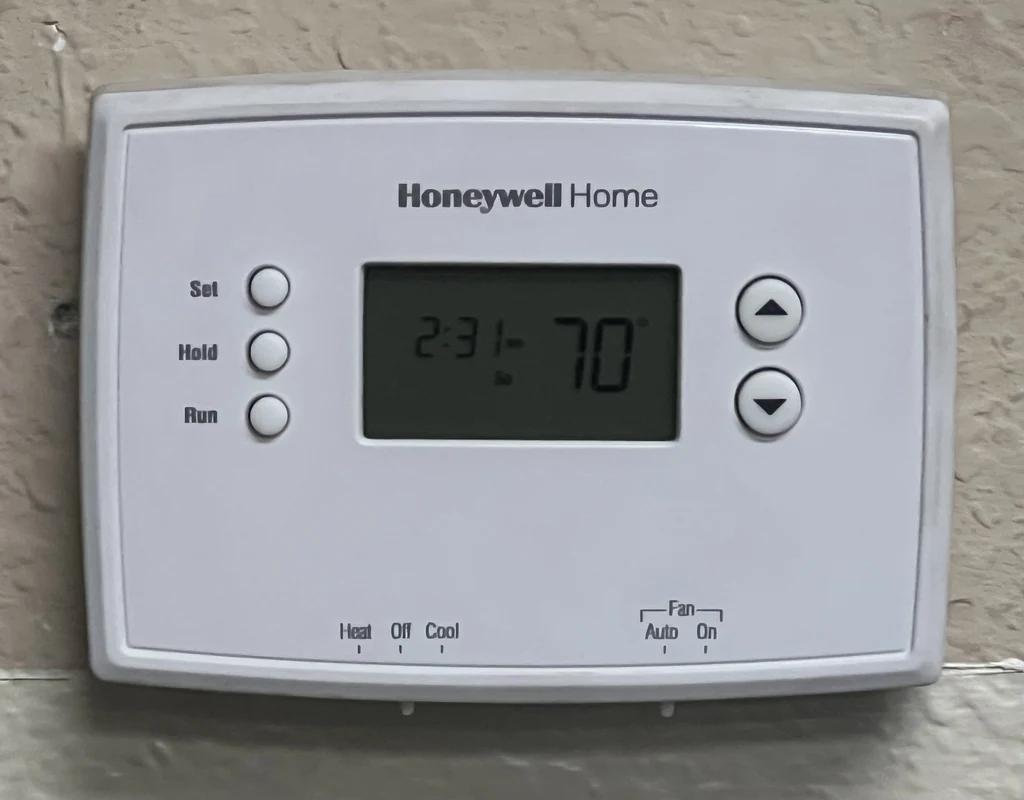
Notice whether sunlight, a nearby heater or a supply register is warming the thermostat while other rooms remain cold. A misleading temperature reading can end the heat call early. Note the location rather than relocating the control yourself. Carrier identifies thermostat sensing, placement and airflow as relevant short-cycling checks.
If the problem began after a thermostat replacement, give the installer the old and new control models and the date of the change. Compatibility, configuration and power supply need checking. Google's Nest troubleshooting guidance recognizes repeated on/off behavior and power-related problems even without an error code. That does not prove that every cycling furnace needs a common wire or a new thermostat.
Check the filter and room airflow
A clogged filter or restricted return can reduce airflow. On a fuel furnace, heat can build up and a limit control can interrupt heating. Carrier explains this airflow and overheating connection.
For a homeowner-serviceable filter:
- Use the furnace instructions to identify the filter location and required size and type.
- Shut the system down and isolate its electrical supply as the manual requires before handling the filter. If you cannot identify the correct procedure, leave the work to service.
- Replace a dirty disposable filter with an approved replacement, or clean a reusable filter only as its instructions allow. Follow the marked airflow direction and close the filter access properly.
- Keep a filter installed. Do not test operation with it removed, stack additional filters or leave a cabinet door open to improve airflow.
Move furniture, rugs or drapes away from accessible supply registers and return grilles. Reopen ordinary room registers that were inadvertently closed. Do not alter motorized zoning dampers or close other rooms to try to force more heat toward a cold room. ENERGY STAR recommends routine filter checks because accumulated dirt slows airflow.
What if the filter is new
“New” rules out neither a fit problem nor a wider airflow problem. Record the replacement's size and type and whether cycling started immediately after the change. Ask the service provider to verify the filter's suitability and actual system airflow. A new filter is not proof that a blower, coil, return duct or zone arrangement is working correctly. The filter guide explains size, type and maintenance decisions.
What the shutdown pattern can tell a technician
Heat runs for a while and then stops early
Restricted airflow and overheating are possibilities, but the symptom does not prove that the limit switch itself is defective. A working safety control can be responding to another fault. Ask for the cause of the interruption to be established before authorizing a replacement control.
A technician may need to measure temperature rise and airflow, assess the blower and ducts, and check fuel input or electrical heating operation as appropriate. ENERGY STAR's maintenance checklist separates professional electrical, blower, combustion and heat-exchanger work from routine owner filter care.
A gas burner lights and then goes out
Ignition, flame proving, burner condition and control problems can interrupt a start. A dirty flame sensor is one possibility, not a diagnosis from the timing alone. Trane lists several causes of a burner shutting off after ignition.
Venting or drainage appears abnormal
Gas oil and electric furnaces need different service branches
If the system is actually a heat pump, or a heat pump paired with backup heat, identify that configuration before applying furnace-only explanations. Use the heat-pump not-heating guide for that branch.
When sizing and installation deserve a closer look
A furnace that has cycled rapidly since installation, or after major insulation or zoning changes, warrants an installation review. Oversizing can produce frequent cycles, but new short cycling is not proof that you need a smaller furnace.
After operating faults are checked, ask the contractor to compare the home's heating load, furnace output and control staging, then assess the distribution system. ENERGY STAR's quality-installation guidance calls for sizing based on the actual home and airflow meeting manufacturer specifications. Floor area or the old furnace's nameplate alone is not that assessment.
At night, note the schedule and which zones were calling when the problem happened. Do not assume colder weather explains a repeated safety interruption, and do not alter zone controls to conceal it.
Stop repeated cycling and get a diagnosis
Give the company:
- The furnace and thermostat models, fuel type and any burner model from existing records.
- Whether the room reached the setting, whether the heat-call display remained on and what the blower did.
- The approximate pattern and when it began, including recent filter, thermostat, installation or zoning work.
- Any alarm, visible code, leak, odor or abnormal sound, without approaching the equipment to reproduce it.
There is no single “short-cycling repair” with one reliable price. Ask what the diagnostic visit includes, what fault was demonstrated, the proposed correction, parts and labor, and how operation will be verified afterward. A control that resets successfully has not necessarily had its underlying problem corrected.
Sources
Read sources and image credits
- PG&E and Propane Education & Research Council: gas and propane safety
- U.S. Consumer Product Safety Commission: carbon monoxide safety
- Trane: furnace owner manuals and troubleshooting
- Carrier: furnace short-cycling guidance
- Google: thermostat troubleshooting
- ENERGY STAR: maintenance and quality installation
- Beckett: oil-burner owner and control information
- NORDYNE E2 electric-furnace manual, Rheem archive
Image: A wall-mounted Honeywell Home thermostat with its cover closed, a digital display and user controls. Photo: Honeywell Home Thermostat.jpg by TaurusEmerald, CC BY-SA 4.0 International. Resized and converted to WebP without cropping. The adapted photograph remains under CC BY-SA 4.0 International.
